Part 1 of Making with What Remains, a public studio for art educators and anyone who makes things
On the banks of the Yamuna in Delhi, a river can be prayed too and poisoned on the same morning. Marigolds float on the surface. Underneath the water carries whatever the city has poured into it. The people have come down to the river at dawn know both these things but they come anyway.
I've been thinking about that river and the art room at the same time. It's an odd pairing until you notice how rarely we are students to hold two truths in one hand.
Studio teaching has a favorite word and the word is mastery. Control of the medium, clean edges, a finish that makes a juror nod…I believe in skill; I ‘ve spent a career teaching it and I'm not about to stop anytime soon. I've also graded a great many beautiful objects that had nothing to say about the mine their pigment came from, the river their rinse water reached, or the strangers whose images trained the software that helped make them. Beauty keeps excellent secrets.
So, this month I want to sit with a question that is easy to ask and surprisingly hard to teach: what obligations travel with our making?
Climate scientists of the IPCC report that warming is already causing widespread loss and that the people who did least to cause it are carrying the most (IPCC, 2023). Our materials arrive in the studio scrubbed off their histories: the acrylic, the copper wire, the laptop. And an image generator can now produce a “watercolor” in 4 seconds, running on data centers, mined minerals, underpaid labor, and millions of pictures taken without anyone asking (Crawford, 2021).
Two traditions are helping me think about this. They are unhealthy disagreement with each other, which is part of why I trust them.
Xenofeminism starts from embracing claim: nothing is natural enough to justify an unfair arrangement. Gender roles, family forms, aesthetic canons, software defaults. People make them, so people can remake them. For an art teacher this turns out to be oddly practical. The settings on a 3D printer, the defaults in Photoshop, the terms of service on a platform were all designed and all of them can be questioned.
Global South ecofeminisms start somewhere else: with land, water, bodies, and the labor of care. Thinkers and organizers from South Asia, Latin America, and Africa have repeatedly shown what extraction costs particular people in particular places, and that those same people are often the ones defending forests, rivers, seeds...
So, one tradition is suspicious of “nature” as a story used to police bodies, and the other defends specific aspects of nature as kin. I don't want to settle that argument here; I want to work inside it.
The first keeps me from getting misty-eyed about a pure past that never existed. The second keeps me honest about who pays for every shiny new tool. What grows out of the friction is something I've been calling an aesthetics of repair: a way of making and judging art that makes visible the relationship a work depends on and holds the maker answerable to them.
Repair here is slow. Its maintenance, the unglamorous daily work that keeps damaged things going. It asks what a work sustains, and for whom, as well as what it shows.
Over the next three Mondays I'll follow three ways that contemporary artists from the global South and its diasporas practice this kind of repair, and I hope you’ll follow along:
1. Tracing what materials carry,
2. Mapping without extraction, and
3. Composing with what's left.
Each post ends with a small challenge for the studio or classroom. The month closes with a free live (online) studio hour on Thursday, December 3rd, at 2:00 PM Pacific Time.
Practice proposition for this week:
Reflect and jot down:
· What is one material in your studio whose origin story you don't know and are curious about?
· Do a little digging on where it comes from? Where will it go when you're done with it?
· What resource does your position give you that you haven't spent yet? [Interpret this as you will]
if you'd like to share what you find, post below using #makingwithwhat remains. Please leave students faces names and words out of it
Sources:
Crawford, K. (2021). Atlas of AI. Yale University Press.
Intergovernmental Panel on Climate Change (2023). Climate Changge 2023: Synthesis Report.
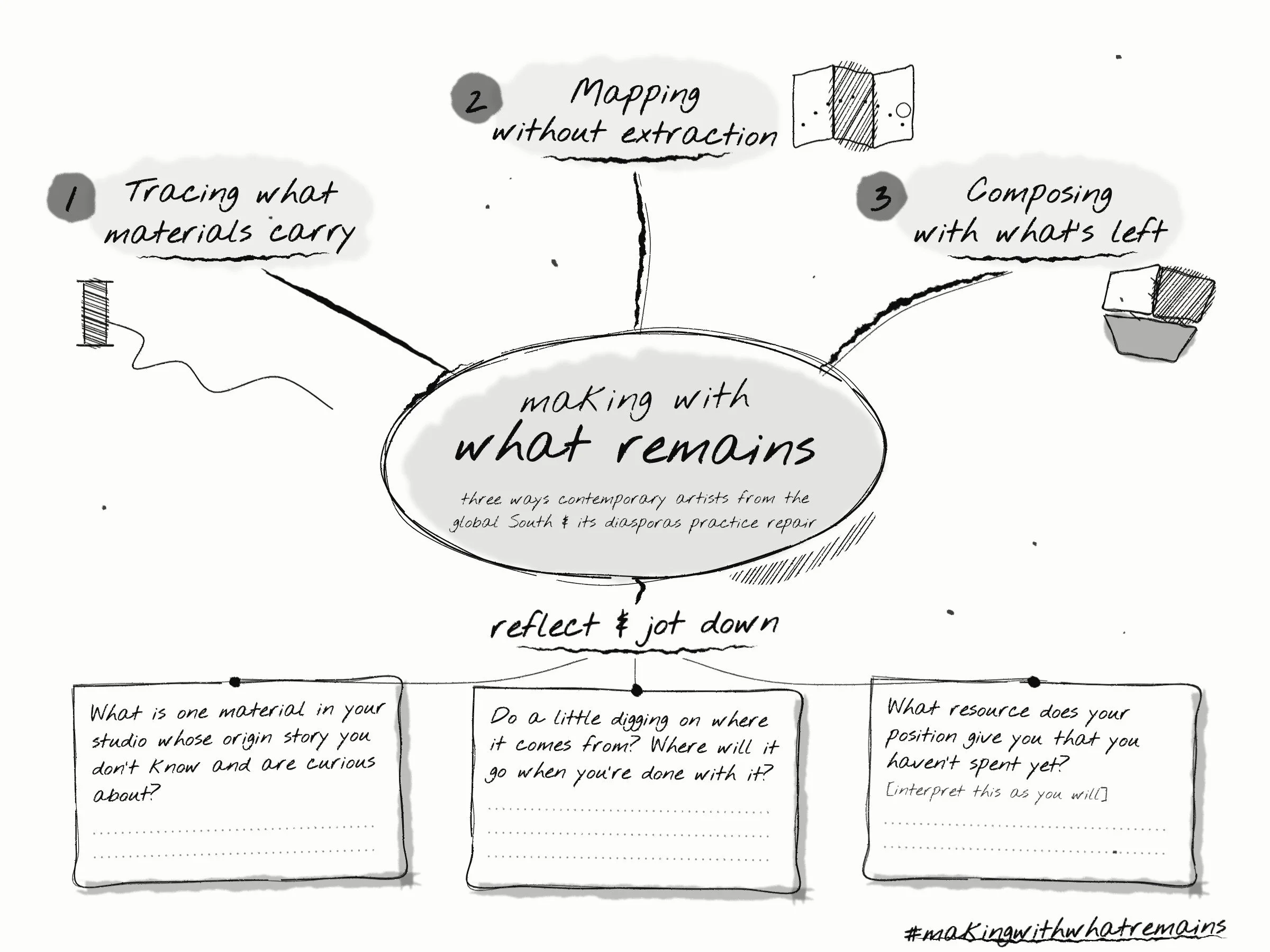
Hand-drawn mind map: making with what remains — tracing what materials carry, mapping without extraction, composing with what’s left , with three reflection prompts